Spatial computing and the industrial metaverse are often discussed in abstract, theoretical terms. But in day-to-day enterprise operations, digital twins are deeply practical. Every digital twin begins on-site with high-density laser scanning, LiDAR reality capture, and millimeter-accurate spatial measurements of physical infrastructure. The challenge is ensuring that these dense 3D spatial models remain accessible, interoperable, and fully owned by the clients who commission them.
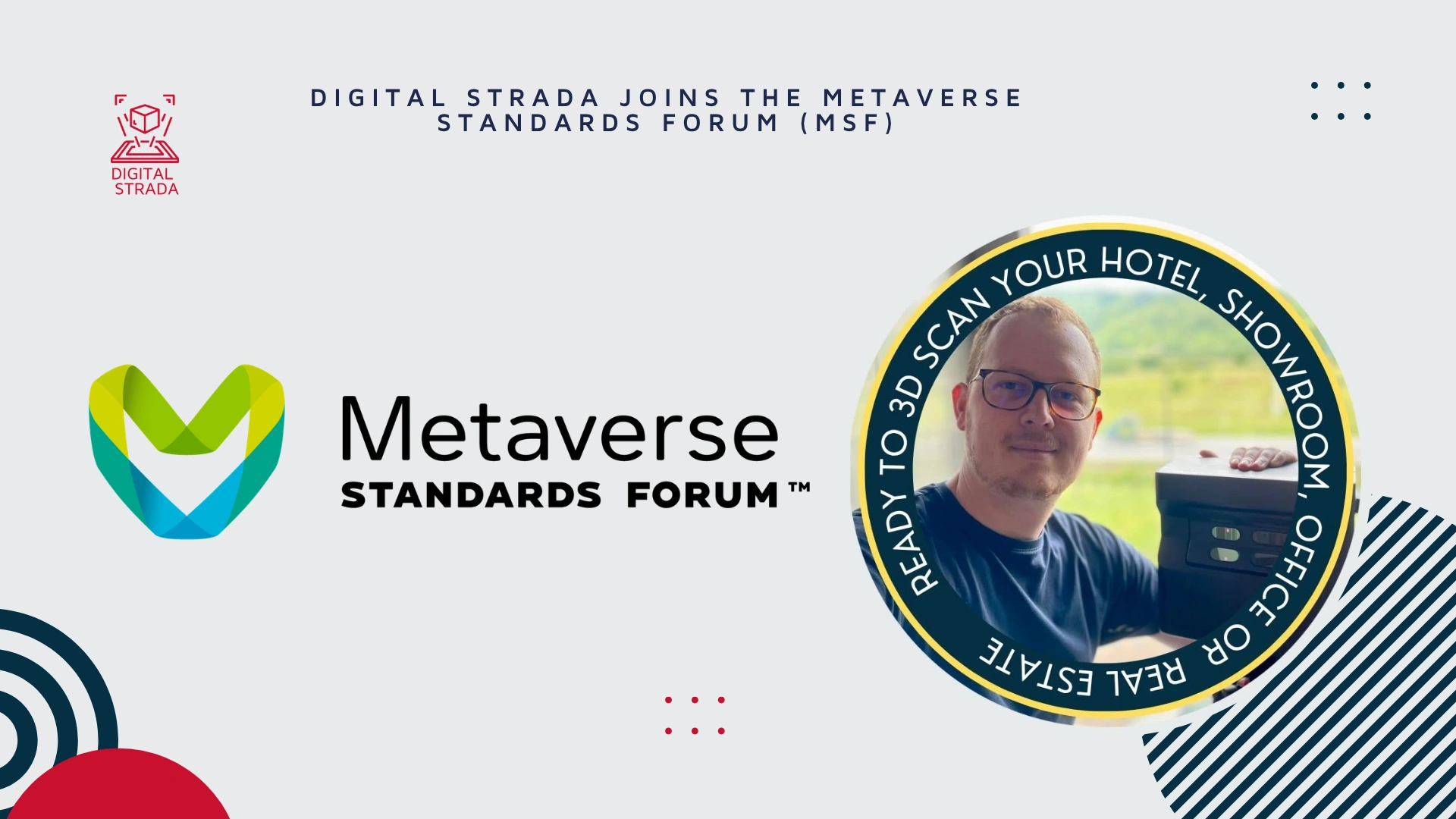
Today, Digital Strada is proud to announce our official membership in the Metaverse Standards Forum (MSF). Operating alongside global industry pioneers including Autodesk, NVIDIA, Khronos Group, Microsoft, Epic Games, and Siemens, we bring frontline reality capture and field engineering experience to the development of open, vendor-neutral 3D standards.
1. The Reality Capture Foundation: Matterport Pro 3, LiDAR & High-Density 3D Meshes
At Digital Strada, our approach to building enterprise digital twins begins with precision hardware and rigorous scanning workflows on the ground:
- Matterport Pro 3 LiDAR Scanning: Utilizing high-speed pulsed LiDAR sensors capable of capturing up to 100,000 spatial points per second at ranges up to 100 meters, delivering high dynamic range (HDR) photorealistic imagery in indoor and outdoor environments.
- Dense 3D Meshes & Textured Geometry: Converting millions of spatial range measurements into optimized, continuous polygonal 3D meshes that accurately reflect surface geometry, structural framing, and MEP routing.
- High-Fidelity Point Cloud Generation: Extracting uncompromised spatial coordinates that serve as the single source of truth for architectural documentation, clash detection, and engineering retrofits.
2. Common Delivery Formats: Why Open Formats Are Essential (E57, OBJ, FBX, IFC, CAD)
A digital twin should never be held captive inside a closed viewer. To maximize operational longevity, Digital Strada engineers every spatial capture project for frictionless handoff into open, industry-standard CAD, BIM, and 3D simulation pipelines:
- .E57 Structured Point Clouds: Vendor-neutral ASTM standard for high-density 3D spatial coordinate data, preserving scan positions, intensity, and RGB color values for ingestion into Autodesk Revit, AutoCAD, and CloudCompare.
- .OBJ & .FBX Textured 3D Meshes: Universal polygonal mesh formats supporting PBR material maps for rapid visualization in Unreal Engine, Unity Industry, Blender, and web viewports.
- .IFC (Industry Foundation Classes) & Scan-to-BIM: Open building data models complying with ISO 16739-1, allowing seamless synchronization across BIM authoring suites and facility management software.
- 2D Layered DWG CAD Plans: Precision schematic floor plans and reflected ceiling plans with Gross Internal Area (GIA) calculations aligned with IPMS standards.
3. Advancing Open 3D Standards with the Metaverse Standards Forum (OpenUSD & glTF)
Joining the Metaverse Standards Forum allows Digital Strada to actively contribute to the standardization and real-world implementation of the next-generation spatial web:
A. OpenUSD (Universal Scene Description)
Standardized by the Alliance for OpenUSD (AOUSD) and championed within MSF, OpenUSD is the premier framework for complex industrial 3D scenes. It enables architects, robotics engineers, and facility teams to non-destructively layer structural LiDAR point clouds, parametric BIM data, and physics-based simulations into a single interconnected digital twin hierarchy.
B. glTF 2.0 (Runtime 3D Transmission)
As the runtime transmission standard developed by Khronos Group, glTF™ delivers compact, efficient 3D models with PBR textures directly to web browsers via WebGL and WebGPU—allowing clients to inspect full-scale facilities on desktop, mobile, and WebXR headsets without installing specialized desktop software.
4. What This Means for Digital Strada Clients and Partners
- Complete Data Sovereignty: You retain 100% ownership of your raw point clouds, 3D meshes, and BIM models in open standard formats with zero vendor lock-in.
- Seamless Ecosystem Interoperability: Direct pipeline connectivity to NVIDIA Omniverse, Autodesk Tandem, AWS IoT TwinMaker, and custom web portals.
- Pragmatic, Engineering-First Delivery: Translating advanced spatial capture technologies into actionable operational value for real estate, heritage preservation, industrial plants, and smart facilities.
Explore our end-to-end reality capture capabilities across our Enterprise Solutions, 3D Digital Twins, and Scan to BIM services.
Ready to Digitize Your Space or Get an As-Built Quote?
Calculate instant 3D LiDAR scan costs, Scan-to-BIM modeling estimates, and software integration pricing in under 30 seconds.