🍫 Confession time: in today’s “spot the difference,” the second image is missing… a chocolate bar. Guilty!
😅 Fun aside — it’s a perfect metaphor for construction: if a chunk “disappears” between plan and site, can you spot it fast enough to fix it?
🏗️ I’m Emil, Founder at Digital Strada for 3D Digital Twins. That’s why we are offering STAGES, our Smart Building Solutions component powered by 3D Digital Twins for the AEC world. Think of it as a living project record that makes progress (and gaps) impossible to hide — from the first sketch to operations.
🧭 Pre-construction: STAGES anchors designs, scopes, and decisions to a single 3D truth. Baselines are versioned, RFIs and approvals are context-aware, and stakeholders see exactly what changed, when, and why — no more “which drawing is final?” debates.
🚧 Active build: Site reality is continuously compared to plan inside the twin. You get real-time visibility of work completed vs. scheduled, clash and snag tracking in model context, and clear “who/when” ownership — so deviations are spotted as quickly as that missing chocolate square.
🛠️ Post-construction & maintenance: STAGES turns handover into a structured, searchable asset. O&M docs, asset registers, warranties, and maintenance tasks live inside the twin, giving FM teams a reliable source of truth for the building’s entire lifecycle — not a dusty binder.
📈 Bottom line: better evidence, faster decisions, cleaner audits, and a calmer project room. If you’d like a walkthrough on an active scheme (or just want to see the chocolate demo), drop me a note.
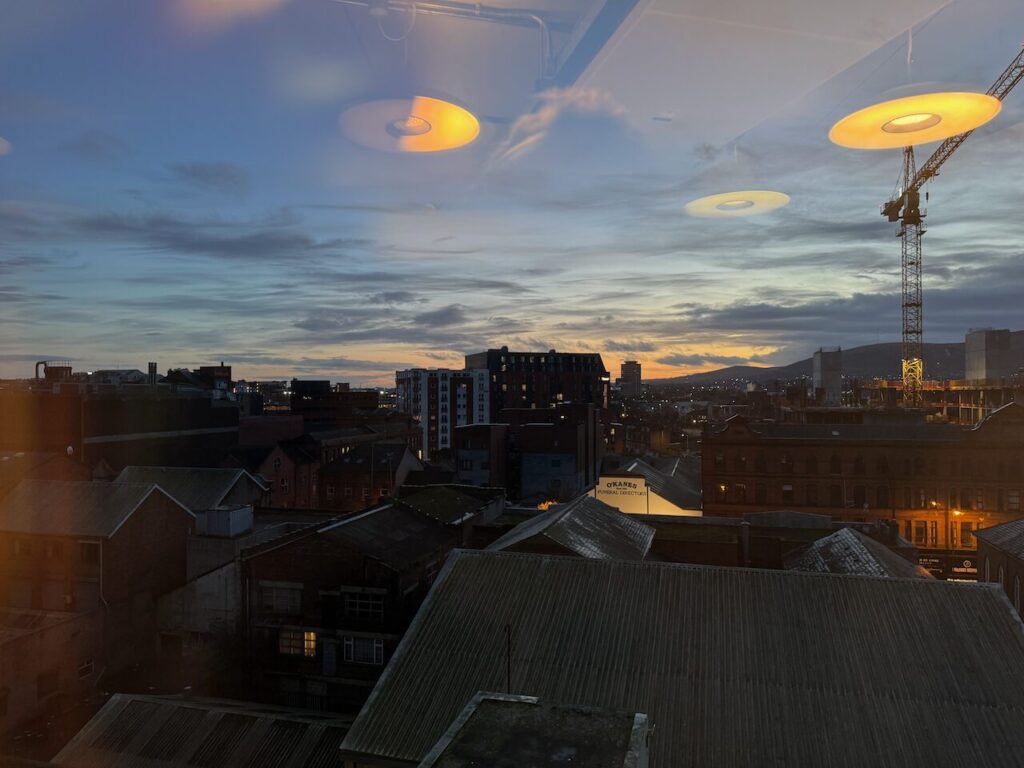
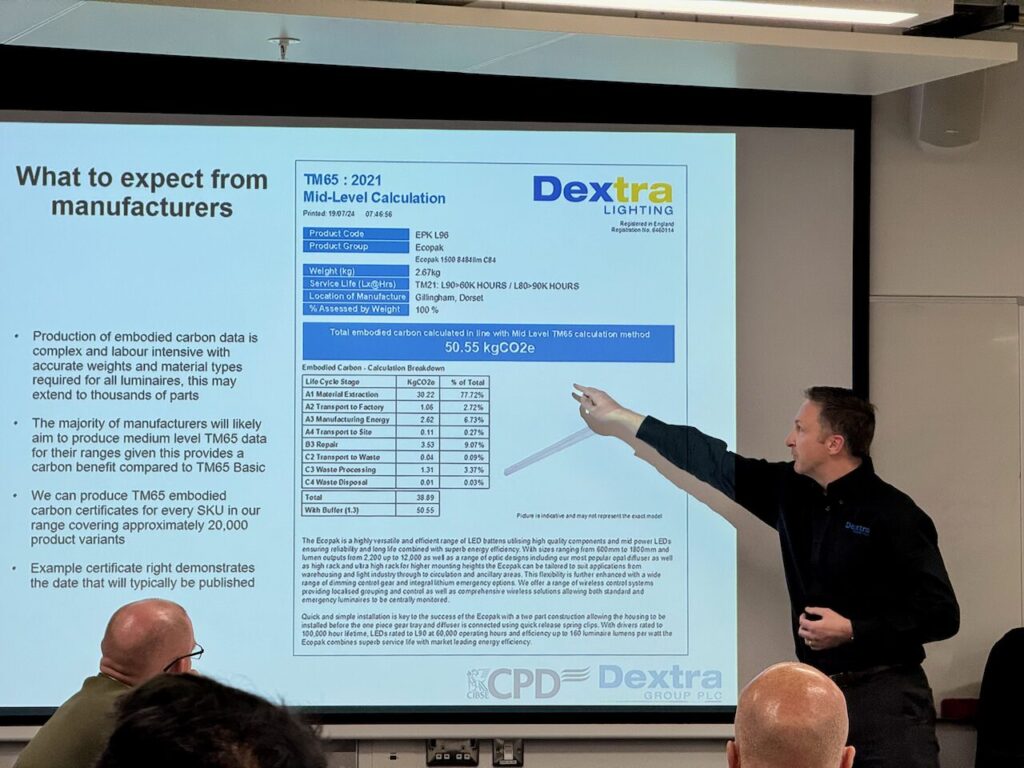
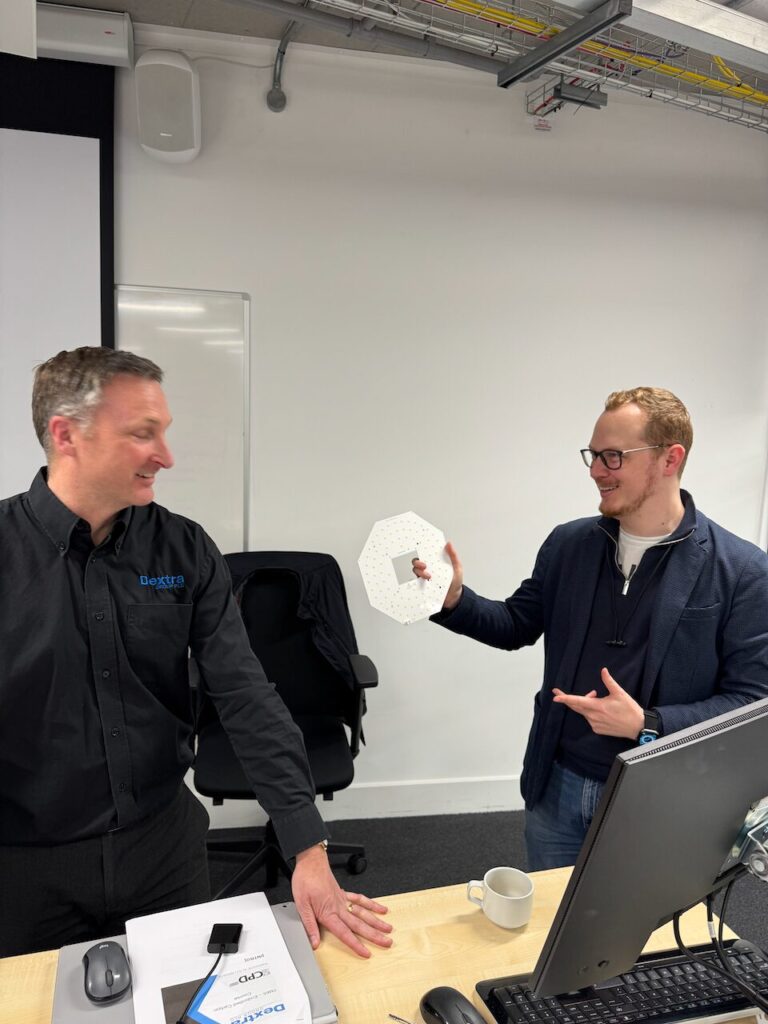
Event: TM65 – Embodied Carbon Calculation in Building Services & Student Prize Giving Date & Time:Tuesday, 25 February 2025 · 17:30–20:00 GMT Venue:Ulster University, Belfast BT15 1ED Context: CIBSE-aligned CPD delivered with Dextra Group PLC, focused on lighting, pragmatic calculations, and what this means for real projects in NI, UK, Ireland and EU.
1) Setting the scene
A full room, plenty of questions, and a topic that finally has teeth. TM65 is about estimating embodied carbon when full EPDs aren’t on the table—and then using that estimate responsibly. For us, it’s the kind of data you want sitting beside assets in a 3D Digital Twin, so decisions aren’t made from gut feel but from something concrete.
2) TM65 in plain English
TM65 focuses mostly on A1–A3 (materials + manufacturing). It’s not a full LCA, and it’s not an EPD—but it standardises how we estimate carbon so we can compare products earlier and push manufacturers toward better disclosure.
3) Route #1 — TM65 Basic
Basic uses total weight and broad material splits with standard factors plus a couple of multipliers. It’s quick and good for early design. The trade-off: uncertainty—especially around electronics.
4) Route #2 — TM65 Medium
Medium swaps the “complexity” multiplier for simple, specific entries: transport to factory, manufacturing energy, transport to site, waste processing/disposal. It’s the sweet spot for tenders when you can get a short BOM from suppliers.
5) Route #3 — EPDs
EPDs (EN 15804) are independent, cover more impacts, and spell out exactly which modules are in scope. When you have an EPD, use it. When you don’t, TM65 is your lifeline—just keep the boundaries straight.
6) Why operational often dwarfs embodied (and when it doesn’t)
TM65 excludes operational electricity. That’s not a flaw; it’s a boundary. But you need to keep it in mind:
Example A (operational dominates): a 1500 mm batten at ~52.9 W, running 24/7 for 10 years on a typical UK grid ends up around 960 kgCO₂e in use vs ~55 kgCO₂e embodied—roughly 19× higher.
Example B (embodied can dominate): a 600×600 modular panel with integral emergency gear, 21.6 W, used ~2,080 h/yr for 10 years can show embodied (~118 kg) overtaking operational (~93 kg).
7) How to compare manufacturers fairly
To avoid apples-to-oranges:
Match function: lumen output, CCT/CRI, optics, lifetime.
Match boundaries: TM65 Basic/Medium vs EPD; list the modules.
Ask for electronics mass (drivers/boards) and materials (alloys, polymers, finishes).
Check serviceability: replaceable drivers/boards beat sealed units for life extension.
Expect an uncertainty band on TM65 estimates.
8) What to expect from manufacturers
As TM65 adoption grows, brands will publish Medium-level certificates per SKU and be challenged to improve them over time. That’s the direction of travel.
9) How product design will change
Expect more design-for-disassembly, higher recycled aluminium, simpler polymers, and a push to right-size luminaires so you need fewer of them. Also: be thoughtful with integral emergency—it adds mass, so use where it truly helps.
10) The honest limits
TM65 is a helpful estimate, not a whole-life answer. Electronics can be under-represented in Basic; comparisons go sideways if scopes don’t match; and, unless verified (like an EPD), data is self-declared. Note it, use it, and keep the context visible.
11) Five simple moves to cut whole-life carbon
Meet the standard, don’t overshoot illuminance.
Cut hours with daylight and presence controls, plus practical schedules.
Choose serviceable luminaires with replaceable drivers/boards and a spares plan.
Prefer recycled/mono-materials, minimal coatings.
Ask early for data: EPDs where possible; otherwise TM65 Medium with assumptions noted.
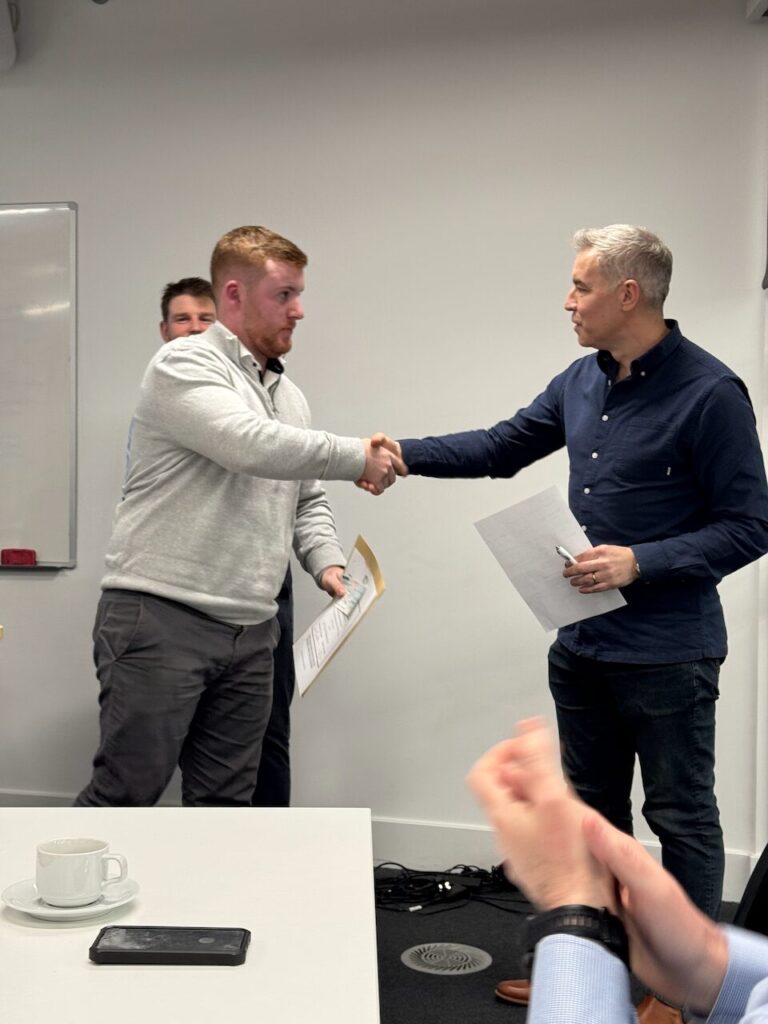
12) Student Prize Giving
The best part of the evening? Seeing students celebrated for exactly the kind of thinking the industry needs—repairability, sensible materials, clear reporting. The future looks capable.
13) Where this meets Digital Strada’s 3D Digital Twins & Facility Management Assets
Capture once, trust always. We use LiDAR scanning to capture buildings accurately and build clear 3D Digital Twins. From that, we deliver the essential CAD/BIM drawings and a clean asset register—so every luminaire, driver and emergency pack is recorded in the right room with the right notes. TM65/EPD details (where available) sit beside each asset in plain language, making choices faster and easier during design reviews and refurb cycles.
Make day-to-day FM simpler. Facilities teams don’t need to hunt through PDFs and emails. In the twin, you can pull up a space, see what’s installed, check service notes/warranty, and view simple carbon info when planning replacements. It’s a straightforward way to balance reliability, cost and carbon without getting tangled in spreadsheets.
Handovers that actually help. Each project handover includes the twin, the drawings, and tidy asset schedules—ready for operations. That consistency makes audits painless and lets you line up like-for-like upgrades across the portfolio when standards or hours change. It’s a practical, low-friction path to smarter maintenance and lower whole-life impact.
🚀 Start a Project When you’re ready, share a few details and we’ll propose scope, pricing, and timelines tailored to your site: https://digitalstrada.com/start-project/
Today’s Apple event delivered a full-stack refresh: the iPhone 17 family (including the ultra-slim iPhone Air and the iPhone 17 Pro/Pro Max), new AirPods Pro 3, and three Apple Watch models (Series 11, SE 3, Ultra 3). Pre-orders begin Friday, September 12, with general availability from Friday, September 19; iOS 26 lands Monday, September 15.
Catch up quick | Apple September event highlights
Here’s a quick recap of the good things coming your way: iPhone 17 Pro, iPhone Air — the thinnest iPhone ever, iPhone 17, AirPods Pro 3, Apple Watch SE 3, Apple Watch Ultra 3, and Apple Watch Series 11.
Introducing AirPods Pro 3 | Apple
The world’s best in-ear Active Noise Cancellation, with up to 2x more noise cancelled than AirPods Pro 2. Exceptional sound quality. All-new heart rate sensing during workouts. A more secure in-ear fit. IP57 dust, sweat, and water resistance. A clinical-grade Hearing Aid feature. Live Translation to communicate across languages. And improved battery life with up to 8 hours of listening time.
Introducing iPhone 17 Pro | Apple
Introducing iPhone 17 Pro. Built from solid aluminum, a unique unibody encases our biggest battery with our longest battery life. The most powerful chip made for iPhone is cooled by an entirely new thermal system. Ceramic Shield protects the back as well as the front, and the display is 3x more scratch resistant. The most cinematic camera we’ve ever made captures ProRes RAW video. With a 56 percent larger sensor, the 8x optical-quality zoom gets you even closer to the action. It’s the first phone to offer genlock, for precise video synchronization and creating Hollywood-level effects. The ultimate Pro. iPhone 17 Pro.
Introducing iPhone Air | Apple
This is iPhone Air. Super thin. Strikingly light. Shockingly strong. Powered by the new A19 Pro chip, which is built for Apple Intelligence. Fitted with our new 18MP Center Stage front camera and an advanced 48MP Fusion camera system that enables Dual Capture, Action mode, next-generation portraits, and much more. All with remarkable all-day battery life.
iPhone 17: ProMotion for the mainstream, a new selfie era
I like the direction here: 6.3-inch Super Retina XDR with ProMotion (120Hz), tougher Ceramic Shield 2 with 3× better scratch resistance, the A19 chip, and an 18MP Center Stage front camera that lets me shoot landscape selfies without rotating the phone. Base storage doubles to 256GB. Pre-orders open September 12; in stores September 19.
Why it matters to my work: ProMotion and the brighter outdoor screen make on-site scanning UIs and live model walkthroughs feel smoother and more legible in harsh light.
iPhone 17 Pro & 17 Pro Max: sustained performance and creator-grade video
The Pro redesign focuses on sustained performance: an aluminum unibody with an Apple-designed vapor chamber, A19 Pro, and three 48MP Fusion cameras with the longest optical-quality zoom yet (up to 8×). For production work, Apple adds ProRes RAW, Apple Log 2, and genlock—features I can actually plug into multi-cam shoots and precise post pipelines. Pre-orders September 12; available September 19.
Creator note: Apple also announced Final Cut Camera 2.0 with ProRes RAW and genlock support on iPhone 17 Pro/Max plus tighter Live Multicam integration—useful for controlled, time-locked capture on site.
iPhone Air: the thinnest iPhone ever
Apple added a brand-new tier: iPhone Air—5.6 mm thin, titanium frame, 6.5-inch 120Hz display, and A19 Pro-class performance. It brings the 48MP Fusion rear camera and the same Center Stage front camera concept as the rest of the lineup. It’s eSIM-only worldwide, which helped enable the slim build. Pre-orders September 12; available September 19.
My read: this will be the business traveler’s favorite—light, durable, pocketable—while power users who want maximum battery and optics stick with Pro.
AirPods Pro 3: better ANC, in-ear HR, and Live Translation
AirPods Pro 3 step up with up to 2× stronger ANC vs. the previous gen, heart-rate sensing (PPG) in the buds, five ear-tip sizes (incl. XXS), IP57 durability, more battery life, and Live Translation for in-person conversations via Apple Intelligence. Pre-order today; available September 19; $249 (US).
Why I care: live, hands-free translation and reliable ANC are fantastic on construction floors, event venues, or mixed-language walkthroughs—exactly where I often present digital twins.
Apple Watch Series 11: thinner, tougher, smarter health
Series 11 adds hypertension notifications (regulatory clearance “expected soon”), a new sleep score, 5G, and Ion-X glass that’s 2× more scratch-resistant, with up to 24-hour battery life. Pre-order today; in stores September 19.
Why it matters: meaningful health signals and more robust glass are exactly what I want for team members who wear a watch on site daily.
Apple Watch Ultra 3: two-way satellite on the wrist
Ultra 3 brings two-way satellite messaging/SOS, the largest Apple Watch display (LTPO3), 5G, and up to 42 hours of battery (72h in Low Power). It’s made for remote work where connectivity is unreliable. Pre-order today; available September 19.
Field impact: satellite on the wrist is a serious safety net during remote surveys or after-hours checks.
Apple Watch SE 3: entry model grows up
The new SE 3 gains an Always-On display, S10 performance, fast charging, 5G, and expanded health features including sleep score. Pre-order today; available September 19.
iOS 26 and Apple Intelligence
iOS 26 ships Monday, September 15 with the Liquid Glass design language and Live Translation across system apps—useful for cross-language communication on client sites. (Companion platform updates roll out alongside.)
Final Cut Camera 2.0 — why this is a real workflow jump
Apple also announced Final Cut Camera 2.0, and this is the bit that turns the new iPhones into proper production tools. The update brings ProRes RAW recording and genlock to iPhone 17 Pro / Pro Max, adds open-gate capture (full-sensor readout for flexible reframing beyond DCI 4K), and ties directly into Live Multicam in Final Cut Pro for iPad. In plain English: higher-fidelity footage, time-locked multi-camera shoots without pain, and more freedom to reframe/stabilise later.
On top of that, 2.0 introduces manual controls for the new Center Stage front camera across the entire iPhone 17 family (including iPhone Air)—so I can shoot horizontal or vertical without physically rotating the phone, while keeping exposure/white balance/focus exactly where I want them. Apple is also adding Apple Log 2 (wider colour gamut in ProRes or HEVC), timecode options (Time of Day, Record Run, or external), and support for the new 200 mm telephoto on iPhone 17 Pro (ProRes up to 4K60). For my shoots, that’s a powerful combo: colour-matchable footage, precise clip identification, and safe standoff zoom for detail grabs.
Crucially, genlock means I can hard-sync an iPhone 17 Pro/Max to other cameras against a single reference signal, producing frame-accurate cuts without manual nudging—exactly what I want for factory walk-throughs, training modules, and twin-embedded explainers where multiple angles must align perfectly. Apple is opening a Genlock API to third parties; Blackmagic is already on board with its Camera ProDock, which signals a healthy accessory ecosystem.
Availability and requirements are straightforward: Final Cut Camera 2.0 will roll out later this month as a free App Store update. It runs on iPhone XS or later with iOS 18.6+, while some features (like ProRes RAW and genlock) require iOS 26 and iPhone 17 Pro hardware. In parallel, Final Cut Pro 11.2 (Mac) and Final Cut Pro for iPad 2.3 will expose proper RAW controls (exposure, colour temperature, tint, demosaic) for these new captures. That’s the end-to-end story: capture, sync, grade—without leaving the Apple pipeline.
How I’ll use it at Digital Strada: I can treat iPhone 17 Pro as a B-cam that truly matches my main rigs: open-gate for safe reframes, Log 2 for colour latitude, timecode/genlock for clean multicam edits, and 200 mm tele for crisp close-ups from a safe distance. Plugged into Final Cut Pro on Mac or iPad, that becomes a lighter, faster, field-ready capture stack for 3D-twin content, site documentation, and stakeholder videos—without compromising accuracy or polish.
What I’ll do with this for clients and partners
Carry less, capture more: With ProRes RAW and genlock on iPhone 17 Pro, I can record color-gradeable footage that time-locks with other cameras for clean cuts in marketing reels, training content, and walkthroughs embedded in digital twins.
Safer remote ops:Ultra 3’s satellite messaging means contact even when a site has zero coverage—ideal for rural hospitality estates, industrial yards, or coastal assets I routinely scan.
Fewer friction points:AirPods Pro 3 + iOS 26 enable bilingual client reviews without extra hardware. I can keep hands free while models, punch lists, and notes flow.
Connecting to my earlier Vision Pro analysis.
Earlier this year I unpacked Apple’s in-store Vision Pro demo and why it signals spatial computing’s industrial leap for 3D Digital Twins: standout accessibility (eye tracking plus wrist/finger/head pointer alternatives), strong spatial persistence and OpenUSD alignment, and a demo lineup (Lowe’s Style Studio, JigSpace, BILT, Freeform, Encounter Dinosaurs) that already maps to real workflows, design previews, interactive maintenance/training, and collaborative planning.
I also called out the IoT overlay potential and the near-term constraints (price around £3,499 and headset weight) alongside encouraging ecosystem signals (e.g., NVIDIA Omniverse streaming, ForeFlight Voyager).
Today’s updates—especially iPhone 17 Pro capture with ProRes RAW/genlock and Final Cut Camera 2.0—complement that trajectory: pocketable, time-locked field capture feeding into high-fidelity, spatial reviews on Vision Pro, end-to-end.
About Digital Strada
I founded Digital Strada to turn spaces into living digital assets—from hospitality venues and workplaces to industrial sites. I combine LiDAR, photogrammetry, and operational data to deliver digital twins that help owners and operators see clearly, decide faster, and tell better stories to their customers and teams.
Impact & Services
My work spans end-to-end capture (Matterport, LiDAR, reality modeling) through to operational twins and Advanced Facility Operating Systems that blend 3D + IoT + FM. I package results as stakeholder-friendly experiences: sales and leasing tours, training content, maintenance overlays, and analytics that cut through noise and drive action.
Emil Indricau, Founder
I’m Emil Indricau, and I lead Digital Strada’s projects across the UK & Ireland and the rest of the World—hands-on in capture, modeling, and experience design. My focus is practical: make spatial data useful.
That means reliable field workflows, crisp visuals, and decisions you can defend in the boardroom or on the site floor.
🎉 Help your customers to Experience Immersive Communication with a Digital Twin for your hotel, resort, restaurant, museum, factory, real estate project or space.
☎️ Leave a comment with your business and let’s connect to deliver a 3D Digital Twin Solution for your Facility Managemnt Team.
Start a Project of 3D Digital Twins and Immersive Experiences now.
To provide the best experiences, we use technologies like cookies to store and/or access device information. Consenting to these technologies will allow us to process data such as browsing behavior or unique IDs on this site. Not consenting or withdrawing consent, may adversely affect certain features and functions.
Functional
Always active
The technical storage or access is strictly necessary for the legitimate purpose of enabling the use of a specific service explicitly requested by the subscriber or user, or for the sole purpose of carrying out the transmission of a communication over an electronic communications network.
Preferences
The technical storage or access is necessary for the legitimate purpose of storing preferences that are not requested by the subscriber or user.
Statistics
The technical storage or access that is used exclusively for statistical purposes.The technical storage or access that is used exclusively for anonymous statistical purposes. Without a subpoena, voluntary compliance on the part of your Internet Service Provider, or additional records from a third party, information stored or retrieved for this purpose alone cannot usually be used to identify you.
Marketing
The technical storage or access is required to create user profiles to send advertising, or to track the user on a website or across several websites for similar marketing purposes.